
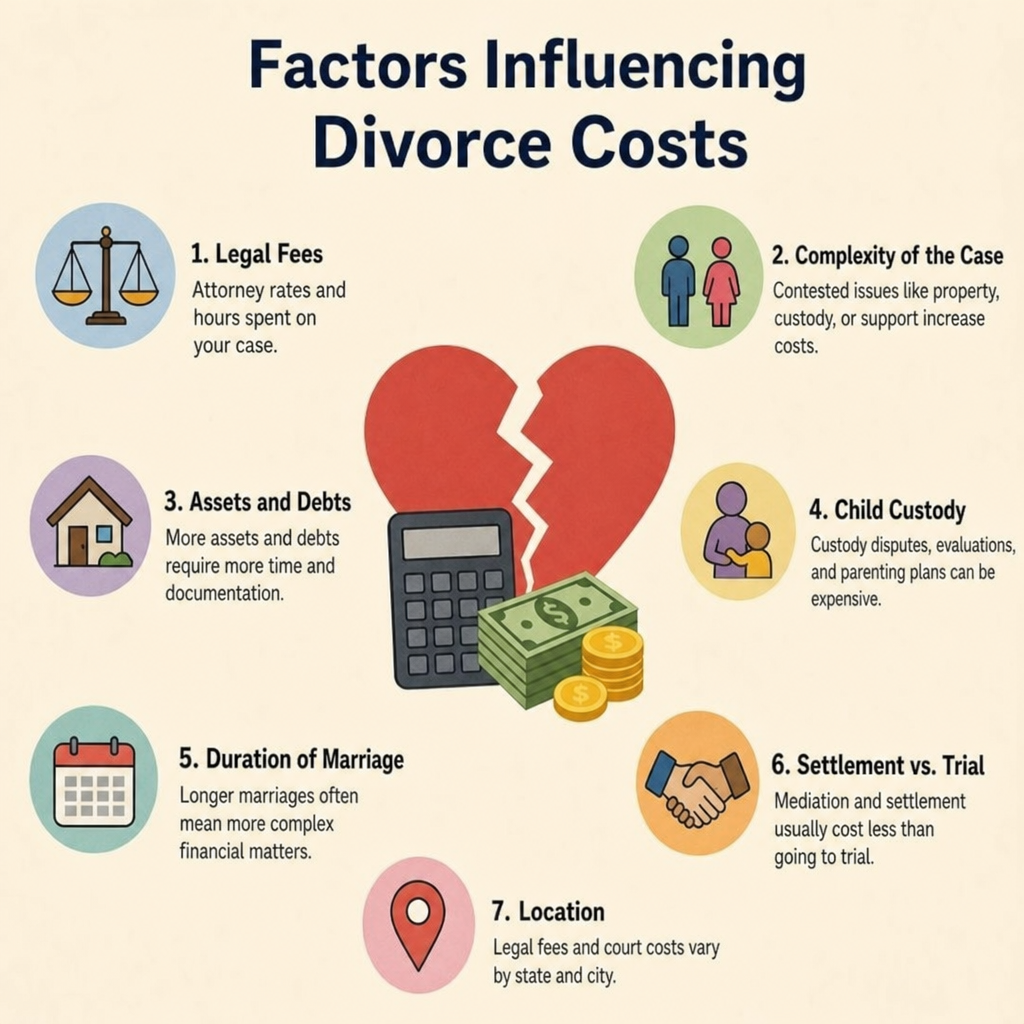
Divorce is not only a hard thing, but is, unfortunately, not free. When people ask about the cost of divorce in California, our answer is that there is simply no single fixed amount.
The total depends on the process used, whether the spouses agree on the main issues, whether lawyers are hired, and whether disputes arise over property, child custody, child support, or spousal support.
Some costs are easy to spot because the courts set them. Others, especially lawyer fees, private mediation fees, and expert costs, can vary a lot from case to case.
For that reason, it is better to look at the different expenses that may arise in a California divorce than to rely on one number said to be the average cost of divorce in California.
So How Much Does It Cost to File for Divorce in California?
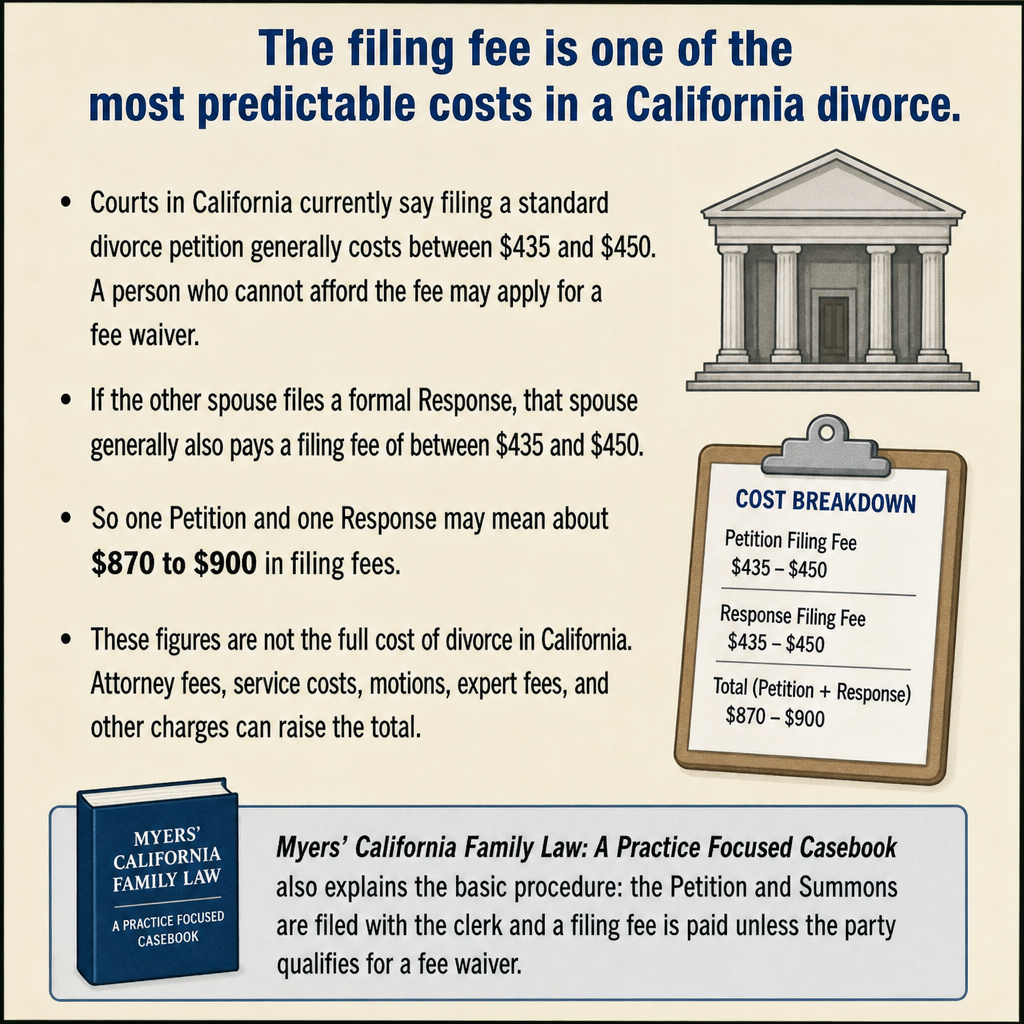
The filing fee is one of the most predictable costs in a California divorce.
Courts in California currently say filing a standard divorce petition generally costs between $435 and $450. A person who cannot afford the fee may apply for a fee waiver.
If the other spouse files a formal Response, that spouse generally also pays a filing fee of between $435 and $450.
So one Petition and one Response may mean about $870 to $900 in filing fees.
These figures are not the full cost of divorce in California. Attorney fees, service costs, motions, expert fees, and other charges can raise the total.
Myers’ California Family Law: A Practice Focused Casebook also explains the basic procedure: the Petition and Summons are filed with the clerk and a filing fee is paid unless the party qualifies for a fee waiver.
California’s Joint Petition Procedure
From January 1, 2026, California allows spouses to file one joint petition to start a divorce or legal separation together.
Under this procedure, both spouses sign and file the same starting documents and are identified as Petitioner 1 and Petitioner 2. The current filing fee is $870.
A joint petition does not finish the divorce. The spouses must still exchange financial disclosures, reach a written agreement on all issues, prepare and file a judgment, and meet the remaining requirements for dissolution. If they cannot agree, either spouse may revoke the joint petition and the case continues as a regular divorce.
The $870 fee is therefore the cost of starting the joint case, not the total cost of getting the divorce.
Summary Dissolution
Some couples may qualify for California’s summary dissolution procedure.
For people asking how much is a simple divorce in California, summary dissolution may be one answer.
Summary dissolution is a simpler and less expensive way to end a marriage or domestic partnership for qualifying couples. In general, the spouses must have been married for less than five years, have no children together, own and owe little, not seek spousal support, and agree on property division.
The current filing fee is between $435 and $450.
For couples who qualify and do not need much professional help, summary dissolution may cost far less than a contested divorce.
Is There an Average Cost of Divorce in California?
A number of sites give figures said to represent the average cost of divorce in California. Treat those figures with care.
Court filing fees can be checked from California Courts. The larger cost of divorce, though, depends on matters the State does not control, including the lawyers hired, the amount of work needed, the issues in dispute, the use of experts, and whether the matter goes to trial.
Consider two examples.
A couple may agree on property, have no contested custody issues, do much of the paperwork themselves, and pay little beyond filing and small incidental costs.
Another couple may dispute ownership of several properties, the value of a business, child custody, spousal support, and how substantial assets are classed. Their case may need broad discovery, expert evidence, repeated hearings, and finally a trial.
Both are California divorces, but the cost will be very different.
So it is more accurate to discuss the parts of divorce cost than to say every California divorce costs, for example, $17,500.
How Much Do California Divorce Lawyers Charge?
From our research and reading, Attorney fees can be the largest expense in a divorce.
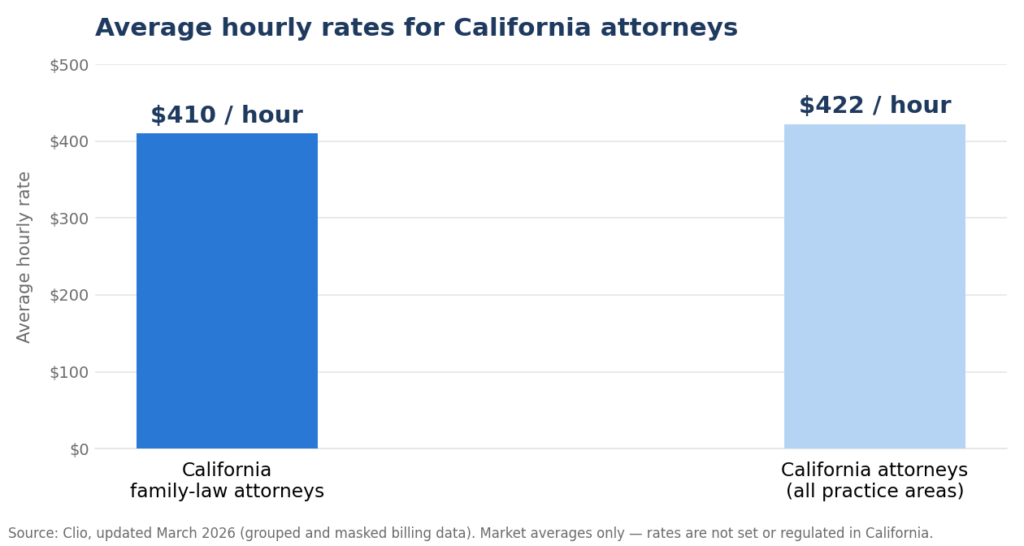
There is no set hourly rate for California family-law attorneys. Lawyers and firms choose their charges based on experience, location, case complexity, and the work required.
Current Clio data, updated in March 2026 and based on grouped and masked billing information, reports an average hourly rate of about $410 for family-law attorneys in California. The average for California lawyers across all practice areas is about $422 per hour.
The $410 figure is a market average. It is not a set or regulated rate, and a specific California family-law attorney may charge much more or much less.
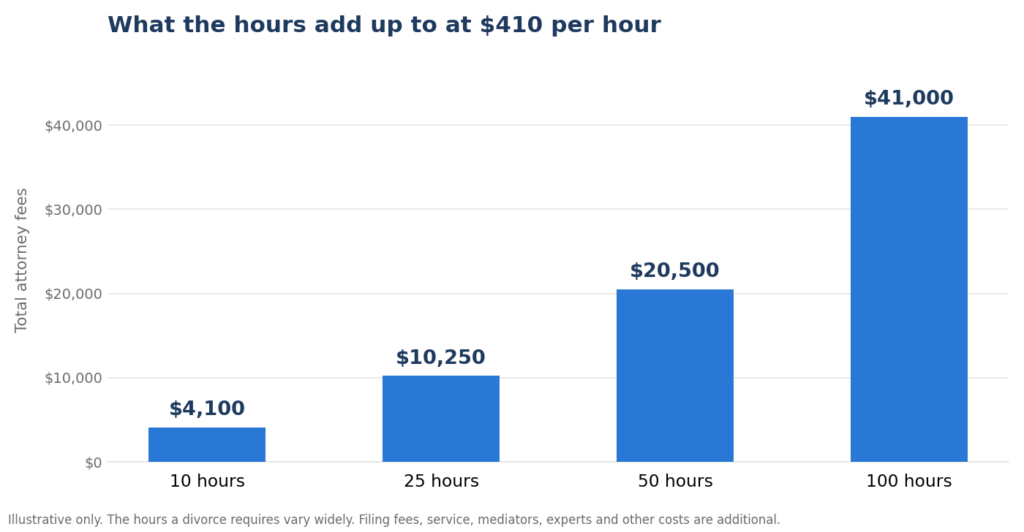
The hourly rate is only part of the cost.
At an example rate of $410 per hour:
- 10 hours of legal work would amount to about $4,100;
- 25 hours would amount to about $10,250;
- 50 hours would amount to about $20,500; and
- 100 hours would amount to about $41,000.
The amount of work required may matter as much as the hourly rate.
Why Attorney Fees Can Increase Quickly
A divorce attorney may spend time advising the client, checking financial records, preparing court papers, corresponding with the other party or attorney, doing discovery, negotiating settlement terms, researching legal issues, appearing at hearings, dealing with experts, and preparing for trial.
A matter that settles fast may need far fewer billable hours than a highly contested case with repeated motions and broad discovery.
Attorneys may also ask for an advance retainer. A retainer is not always the full price. Depending on the fee agreement, legal work may be billed against the retainer and the client may later need to add more.
California Courts tells clients to understand how they will be charged before hiring a lawyer and notes different fee arrangements, including fixed-fee and other billing plans.
How Much Does an Uncontested Divorce Cost?
An uncontested divorce often costs less than a heavily contested case because fewer issues need court decisions.
But it would be wrong to give one fixed price for every uncontested divorce.
One couple may do much of the process themselves and pay little beyond the filing fees.
Another couple may agree to divorce but still hire lawyers to help with a family business, retirement benefits, taxes, real property, spousal support, or the wording of their settlement agreement.
Both cases may end up uncontested, but the costs can differ a lot.
Myers identifies four traditional paths through a California divorce and says that when spouses agree and proceed by Default with Agreement, the lack of a Response saves the response filing fee and agreement also avoids litigation costs.
The broader point is simple: the amount of disagreement between the spouses can strongly affect the total cost.
Mediation Costs in California
When discussing mediation costs, it is important to separate court-connected child custody mediation from private divorce mediation.
Court-Connected Child Custody Mediation
Where custody or visitation is contested, California requires mediation.
The Judicial Branch of California says courts provide trained mediators to families at no cost. A parent who uses a private mediator outside the court must pay that mediator’s fees.
So it is wrong to say, in general, that divorce mediation in California costs between $2,000 and $7,000.
Court-connected custody mediation may cost nothing.
Private Divorce Mediation
Private divorce mediation is different.
The spouses may hire a private mediator to help resolve some or all financial and family issues from the divorce. Private mediators set their own fees.
The final cost may depend on:
- the mediator’s hourly or session rate;
- the number and length of sessions;
- the complexity of the financial issues;
- whether lawyers take part;
- whether other professionals are needed; and
- how fast the parties reach agreement.
There is no set statewide price for private divorce mediation.
Instead of treating a private-provider price range as if it were a rule of California law, the more accurate view is that private mediation costs vary based on the mediator and the facts of the case.
Collaborative Divorce
Collaborative divorce is another option to traditional contested litigation.
In a collaborative process, the spouses and their professionals try to settle the issues through negotiation and cooperation rather than preparing for a contested trial.
If successful, this may reduce some of the cost tied to litigation. But it does not mean every collaborative divorce will be cheap.
Both spouses may still hire lawyers, and financial or other professionals may also be involved.
There is no single fair price for every collaborative divorce.
Property Disputes Can Increase Divorce Costs
Property issues can raise the complexity and cost of a California divorce.
Questions may arise about whether an asset is community property, separate property, or in some cases quasi-community property.
There may also be disputes over:
- tracing;
- reimbursements;
- businesses;
- real property;
- pensions and retirement accounts;
- stock options;
- debts;
- commingled funds; or
- alleged breaches of trust.
California property law can require careful legal and factual analysis. Myers explains that property acquired by a spouse while domiciled outside California may count as quasi-community property if it would have been community property had the acquiring spouse been domiciled in California at the time of purchase.
A divorce with only ordinary household assets is therefore very different from one that needs tracing, classification, and valuation of companies, investment portfolios, pensions, or several properties.
Experts and Other Professional Costs
Some divorces need professionals besides the lawyers.
Depending on the issues, these may include:
- forensic accountants;
- business valuers;
- real-estate appraisers;
- pension specialists;
- tax professionals;
- child custody evaluators; or
- other expert witnesses.
There is no reliable statewide price for these services.
A valuation of a fairly simple asset may require limited work. Valuing a large private company or rebuilding years of disputed financial transactions may require much more.
The need for specialist evidence is another reason the full cost of divorce cannot fairly be reduced to one statewide average.
Can One Spouse Be Ordered to Pay the Other’s Attorney Fees?
Yes, in the right cases.
California Family Code § 2030 requires the court in dissolution, nullity, and legal-separation cases to make sure each party can get legal representation. Where there is a gap in access to funds and one party can pay for legal representation for both, the court must make a proper order for attorney fees and costs.
Family Code § 2032 says the award must be just and reasonable based on the parties’ relative circumstances.
This does not mean the spouse with the higher income automatically pays every legal expense of the other spouse.
The court looks at the statutes and the parties’ circumstances.
Attorney-Fee Sanctions Under Family Code § 271
Attorney-fee orders can also arise for another reason.
California Family Code § 271 lets the court base an award of attorney fees and costs on the extent to which a party’s or attorney’s conduct furthers or blocks California’s policy of encouraging settlement and cooperation and, where possible, reducing litigation costs.
An award under § 271 is a sanction.
The provision therefore reinforces an important practical point: needlessly increasing the cost and difficulty of family litigation can itself have financial consequences.
Fee Waivers
A person who cannot afford the filing fee may be able to get a fee waiver.
California Courts says a person may qualify if they receive certain public benefits, fall below the income limit, or cannot afford the court fee while still meeting basic household needs.
A fee waiver only covers court charges.
It does not mean private lawyers, mediators, accountants, or other professionals must work for free.
Free Court Self-Help Services
Every California superior court has free legal help for family-law matters for people without their own lawyer.
Self-Help Center staff may give legal information, help with court forms, and explain legal options. They do not become the person’s lawyer, give individual legal representation, or go to court for the person.
For someone with a fairly simple divorce, these services may reduce the need to pay a lawyer just to understand basic forms and court procedure.
Limited-Scope Representation
A person does not have to choose between hiring a lawyer for the entire divorce and handling everything alone.
California recognizes limited-scope representation.
Under this setup, the lawyer handles certain parts of the case while the client handles the rest. California Courts lists limited-scope representation as one way to get legal help while keeping costs down.
For example, a lawyer might be hired only to:
- advise on a hard property issue;
- review a proposed settlement;
- prepare certain documents;
- handle discovery;
- advise on custody or support;
- prepare a person for a hearing; or
- appear on one specific issue.
Limited-scope representation can be a middle ground between full representation and full self-representation.
What Usually Makes a California Divorce More Expensive?
The total cost tends to rise as the amount and complexity of disputed work rise.
Factors that may raise costs include:
- strong disagreement between the spouses;
- repeated court motions;
- contested child custody;
- complex property holdings;
- ownership of businesses or professional practices;
- large discovery;
- disputed separate-property claims;
- claims that assets were hidden;
- forensic accounting;
- expert evidence; and
- trial.
Myers notes that uncontested paths to judgment can often be completed mostly through documentary procedures, while a truly contested case may move through settlement conferences, evidence prep, and finally a bench trial.
So asking only how much a divorce costs leaves out one of the most important questions: how much of the divorce will truly be contested?
How Can Divorce Costs Be Reduced?
There is no method that guarantees a cheap divorce. Still, several steps may help reduce needless spending.
Depending on the facts, spouses may consider:
- settling issues that truly do not need litigation;
- using California’s free court Self-Help Centers;
- checking whether they qualify for summary dissolution;
- considering a joint petition if they expect agreement;
- using court-connected Family Court Services for custody mediation;
- considering limited-scope legal help;
- keeping financial records organized;
- replying promptly to fair requests for information; and
- learning the lawyer’s billing terms from the start.
Not every dispute should be settled just to save money. Some issues truly need a judge.
The point is that conflict with no useful legal purpose can make an already costly process much more costly.
California’s statutes reflect that policy through Family Code § 271, which encourages cooperation, settlement, and the reduction of needless litigation costs.
Conclusion
There is no single useful answer to the question, how much does a divorce cost in California?
The court filing fees are fairly easy to identify. Filing a standard Petition generally costs between $435 and $450, and a spouse who files a formal Response generally pays a similar amount. California’s joint-petition procedure currently costs $870, while qualifying couples using summary dissolution generally pay between $435 and $450.
Everything beyond those fees depends a lot on the facts of the case.
Attorney involvement can become the largest expense. Current industry data says the average hourly rate is about $410 for California family-law attorneys, but the final legal bill depends on how many hours the case needs.
A case with major property issues, contested custody, discovery, experts, and trial may therefore cost far more than a simple divorce in which the spouses agree.
The better question is not just: how much does divorce cost in California?
It is: what process will the divorce need, which issues are truly disputed, and what professional help will be needed to resolve them?
Those facts are what ultimately set the cost.
DISCLAIMER
The information published on Vigilante Scholar is for general educational and informational purposes only and does not constitute legal advice. The author is not admitted to practise law in California. Nothing on this website creates an attorney-client relationship. Readers requiring advice regarding their particular circumstances should consult an attorney licensed to practise in California.